


Introduction
Last month I wrote about Google's plans to acquire Wiz. I had concerns about how they would integrate the platforms.
The acquisition closed on March 11, 2026. That was fast.
Now I am seeing the first signs of integration. Some are exciting. Some are concerning.
Security Command Center changed terminology. Attack paths are now called "issues." That is Wiz's wording.
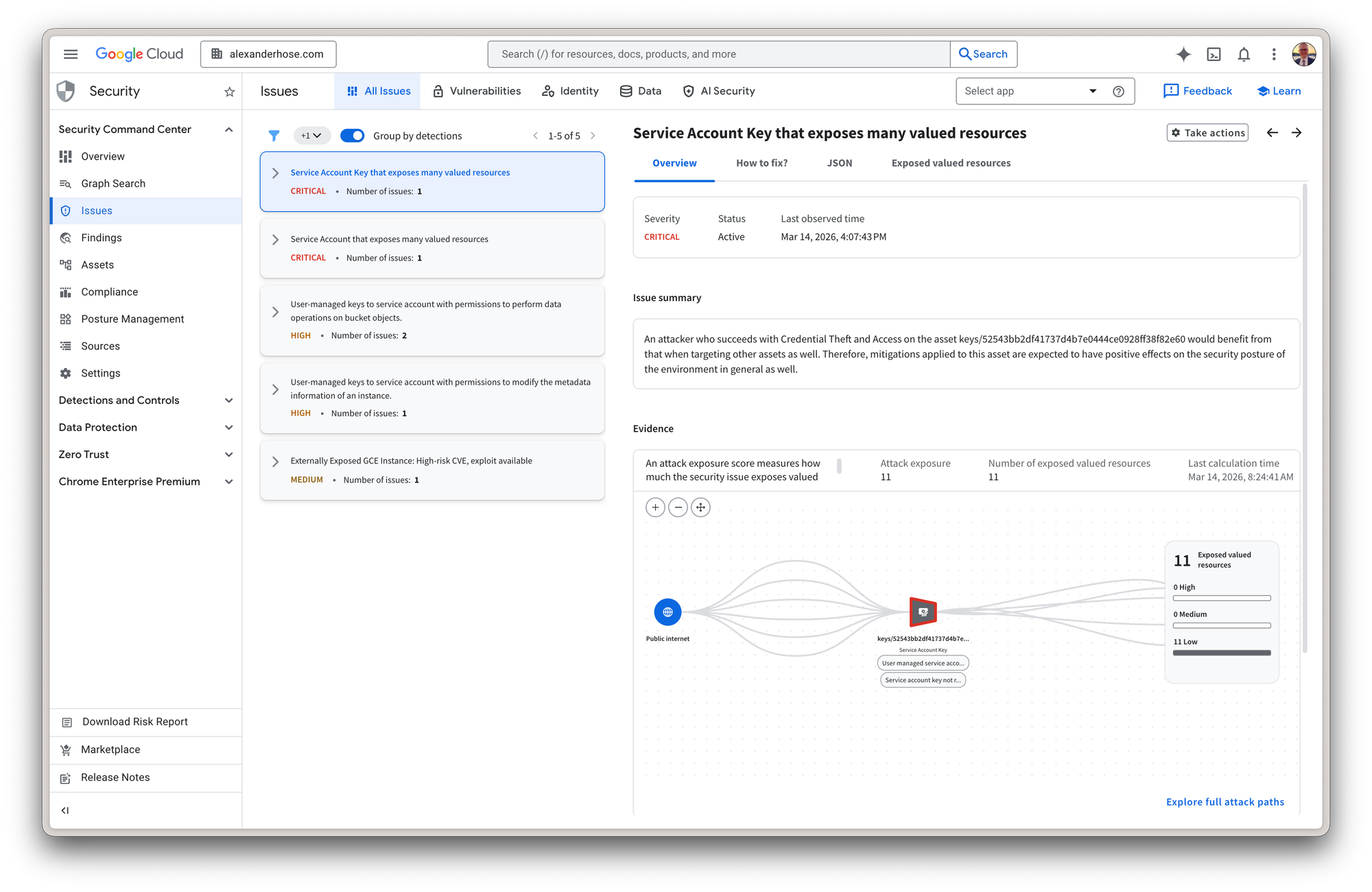
This might seem minor. But I think it signals something bigger. Google is potentially preparing to deprecate Security Command Center.
The Terminology Change
I noticed it a few days after the acquisition closed. Security Command Center's attack path analysis feature got renamed to "issues".
Wiz calls their findings "issues." Security Command Center called them "attack paths".
Google changed SCC to match Wiz's terminology. Google is making Security Command Center look more like Wiz. That tells me they are planning a migration path.
I built custom threat detections in Security Command Center. I automated finding enrichment. I integrated SCC into my security workflows.
If Google deprecates Security Command Center, all that work needs migration.
I wrote in my previous article that I wanted Path 3: integration between Wiz and SCC. Both platforms coexist with clear boundaries.
The terminology change suggests Path 2: Wiz replaces Security Command Center.
Lets see if I am right.
What Google Is Saying
Google's blog post about the acquisition talks about "combining" platforms. They mention "unified security platform" and "next-generation security platform".
They do not say "Security Command Center will continue as our GCP-native platform".
They also do not say "Wiz will feed findings into SCC."
They say Wiz will "join Google Cloud" and they will "retain the Wiz brand".
Retaining the Wiz brand makes sense for marketing. But what happens to the Security Command Center brand?
The blog post emphasizes Wiz capabilities. The Wiz Security Platform. Wiz's cloud and AI security. Wiz's exposure management.
Security Command Center gets mentioned once. As part of "Google Unified Security" alongside Threat Intelligence and Security Operations.
This feels like Google is positioning Wiz as the flagship security product. Security Command Center becomes a legacy platform. From my point of view Wiz is also the much stronger product in comparison to Security Command Center.
The Multi-Cloud Tension
Google promises Wiz will remain multi-cloud. The blog post says "Wiz products will continue to work and be available across major clouds, including Amazon Web Services, Microsoft Azure, and Oracle Cloud Platform."
This is important. Wiz built their business on being cloud-agnostic. Most Fortune 500 companies run multi-cloud. They need security platforms that work everywhere.
But here is the tension. Google owns Wiz now. They want to sell Google Cloud. Every feature Wiz adds to AWS or Azure is a feature that could be GCP-exclusive.
Wiz historically released features on AWS first. AWS has the largest market share. AWS customers pay the most. It made business sense.
Now that Google owns Wiz, will that change?
I expect feature releases to prioritize GCP. New integrations will launch on GCP first. Deep runtime monitoring will work best on GCP services. Cloud Run integration. Gemini-powered analysis.
These GCP-native capabilities will be better than what Wiz offers on AWS or Azure. Because Google controls both the cloud platform and the security tool.
This worries me. Wiz's value was being truly multi-cloud. If they become "multi-cloud with GCP advantages," they lose credibility.
AWS and Azure customers will question Wiz's independence. Why pay for Wiz when the best features only work on GCP?
Competitors like Orca Security, Prisma/Cortex Cloud, and Upwind will use this against Wiz. "We are truly cloud-agnostic. Wiz is owned by Google."
Google needs to prove Wiz stays neutral. They need to keep investing in AWS and Azure features. They need to ship features to all clouds simultaneously.
If they do not, Wiz's multi-cloud reputation dies.
The Integrations I Want to See
Despite my concerns, I am excited about some integration possibilities.
Deep Cloud Run Runtime Monitoring
Cloud Run is Google's serverless container platform. It is excellent for running containerized applications without managing infrastructure.
But Cloud Run security monitoring is limited. You get basic logging. You get Cloud Audit Logs. You do not get deep runtime visibility.
What processes are running inside containers? What network connections are they making? What files are they accessing?
This data exists. But Google does not expose it through APIs. You cannot see it in Security Command Center. You cannot monitor it with third-party tools.
Wiz has deep runtime monitoring using eBPF. They scan container behavior at the kernel level. They see process executions, network connections, file access.
Now that Google owns Wiz, they can integrate this into Cloud Run. Give Wiz kernel-level access to Cloud Run containers. Surface runtime behavior in Security Command Center or Wiz.
This would be huge. I work with customers who want runtime security for Cloud Run. Currently there is no good solution besides of SCC native Cloud Run Threat Detection.
If Google delivers this, Cloud Run becomes more attractive for security-sensitive workloads.
API Access to Previously Unavailable Services
Some GCP services do not expose security data through APIs. You cannot programmatically access certain logs or configurations. You cannot integrate them with external security tools.
Google could open these APIs to Wiz. Give Wiz access to internal service data that other tools cannot reach.
This creates unfair competitive advantage. But it also creates better security for GCP customers.
I am conflicted about this. I want the best security for my GCP environments. But I also want fair competition and open ecosystems.
What Wiz Brings to GCP
The acquisition is not just about what Google gives to Wiz. Wiz brings real value to GCP.
Wiz has expertise in CNAPP platforms. They understand cloud security posture management, Kubernetes security, runtime protection, and vulnerability management.
Security Command Center has good features. But it is not as polished as Wiz. The UI is inconsistent. The risk prioritization is less sophisticated. The integrations and capabilities are limited.
Wiz's product team can improve Security Command Center. Or replace it. Either way, GCP gets better security tooling.
Wiz also brings customers. Fortune 500 companies use Wiz. Many run on AWS or Azure. Google wants those workloads on GCP.
The pitch becomes: "You already use Wiz. Come to GCP where Wiz integration is deepest. Get better security. Get better performance. Get Gemini-powered threat detection."
This could work. Enterprise customers care about security. If GCP offers genuinely better security through Wiz integration, some will migrate workloads.
My Predictions
Here is what I think happens in the next 12 months:
Security Command Center enters maintenance mode. Google will not deprecate it immediately. But new features will stop. Investment will shift to Wiz.
Wiz becomes Google Unified Security Platform. The branding will change. Wiz will be positioned as Google's flagship security product. It will absorb Security Command Center's GCP-native features.
GCP-exclusive Wiz features launch. Deep Cloud Run monitoring. Gemini-powered analysis. These will work only on GCP.
Multi-cloud features slow down. Wiz will still support AWS and Azure. But new features will prioritize GCP. Release cycles for AWS and Azure will lengthen.
Competitors exploit this. Orca Security, Prisma/Cortex Cloud, and Upwind will attack Wiz's multi-cloud credibility. "Wiz is owned by Google. We are truly independent."
Enterprise customers stay with Wiz anyway. Most large enterprises already use Wiz. They will not switch because of acquisition concerns. They will watch to see if product quality declines.
Small customers reconsider. Startups and mid-market companies will evaluate alternatives. They worry about vendor lock-in. They do not want a security platform that pushes them toward GCP.
I am torn on this acquisition.
As a GCP user, I am excited. Better security tooling. Deeper integrations. Access to services that were previously locked down.
But as someone who values open ecosystems and fair competition, I am concerned.
Wiz was valuable because they were independent. They worked equally well on all clouds. They had no incentive to favor one platform.
Now they are owned by Google. That independence is gone.
Google says Wiz will stay multi-cloud. I believe they mean it. But incentives matter more than promises.
Google's incentive is to make GCP more attractive. The easiest way to do that is to make Wiz work better on GCP.
I wrote in my previous article about GCP security transformation that I was optimistic about the acquisition. I still am.
But I am also more worried than I was last month.
The terminology changes in Security Command Center are just the beginning. More changes are coming.
I hope Google proves my concerns wrong. I hope they keep Security Command Center alive. I hope Wiz stays truly multi-cloud. I hope feature parity continues across all clouds.
But the early signs suggest otherwise.
What This Means for You
If you use Security Command Center, start planning for migration. I do not know when it will happen. But I think it is coming.
Document your custom findings, Security Health Analytics, etc. Understand your integrations. Know what you built on top of SCC.
If you are evaluating CNAPP platforms, consider the vendor lock-in implications. Wiz is excellent. But it is now owned by a cloud provider.
If you are on GCP and not using Wiz yet, this is probably a good time to evaluate it. The integration is only going to get better.
Member discussion